Learn about the Compressor
Common Question:
The vending machine is not getting cold, and the technician said it has a leak. Is this possible for a machine that is only one year old?
The same inspection process should be followed, including checking the filter screen, cooling fans, operating mode, and refrigeration parameters.
Another important point to note is that if the temperature is set too low, the evaporator may freeze. When this happens, it can restrict proper airflow and prevent the machine from cooling effectively.
These factors can contribute to compressor issues or damage, even if the machine is less than one year old.
Upon Inspection:
Loud Noise = it may be a problem with the compressor.
Note:
Condensation on the evaporator can cause oxidation and holes in the copper or aluminum pipes or weld joints over time.
This can even at anytime from few months (less than a year) to few years
What R290 is ( 2024 and up )
R290 (Modern refrigerant — propane)
Type: Natural hydrocarbon (propane)
Pros
Extremely low environmental impact 🌍
Very energy efficient (lower electricity cost)
Excellent cooling performance
Now common in EU vending machines
Cons
Flammable ⚠️
Must be serviced by trained technicians
Strict safety rules
R290 = Propane (high-purity refrigerant grade) used in modern cooling equipment.
Type: Refrigerant gas
Chemical: Propane (C₃H₈)
Charge amount: 80 grams
Used in: New vending machines, refrigerators, display coolers, freezers
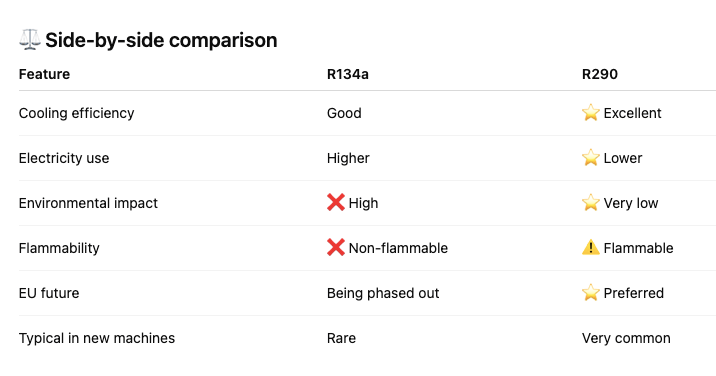
Why many machines now use R290
R290 has largely replaced R134a in new equipment, especially in the EU.
Very energy-efficient
Environmentally friendly (very low global warming impact)
Excellent cooling performance
Required by newer environmental regulations
⚠️ The trade-off: it is flammable
How it works (same system as R134a)
The refrigeration cycle is identical — only the gas is different.
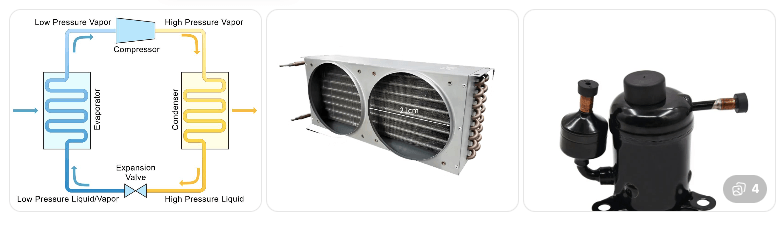
Compressor — pumps the refrigerant
Condenser — releases heat outside
Expansion device — lowers pressure
Evaporator — absorbs heat inside (creates cold)
👉 R290 is the fluid circulating through these parts.
What “80 g” means
That’s the exact amount of refrigerant charge inside the sealed system.
Very small quantity
Precisely measured at the factory
Important for correct cooling performance
Small hydrocarbon charges (like 80 g) are standard for vending machines.
Your machine contains BOTH:
Compressor → mechanical pump (metal component)
R290 (80 g) → refrigerant gas inside the system
⚠️ Important safety note (EU)
Because R290 is propane:
Do NOT puncture refrigeration lines
Do NOT use open flames near leaks
Only certified technicians should service or recharge
What R134a is (Old standard refrigerant)
R134a is a chemical gas used in cooling systems to absorb heat and produce cold. In vending machines, it circulates through the sealed refrigeration circuit to keep drinks or food chilled.
Type: Refrigerant (cooling fluid)
Chemical name: 1,1,1,2-Tetrafluoroethane
Common uses: Vending machines, refrigerators, car A/C systems, small commercial coolers
❌ What it is NOT
It is not a mechanical part.
Not a compressor
Not a motor
Not a pump
Type: Synthetic chemical (HFC)
Pros
Non-flammable (safer to handle)
Stable and widely used for decades
Easy servicing
Cons
High environmental impact (greenhouse gas)
Being phased out in the EU
Slightly less energy-efficient than newer options
How it works inside a vending machine
Think of the refrigeration system as a loop with different components:
Compressor — squeezes the refrigerant gas (raises pressure & temperature)
Condenser — releases heat to the outside air
Expansion device — drops pressure
Evaporator — absorbs heat inside the cabinet (creates cooling)
👉 R134a is the fluid flowing through all these parts.
🔧 Simple analogy
Compressor = heart (pumps the system)
R134a = blood (carries heat around the system)
Common Questions
How long R290 machines typically last
👉 10–15 years is normal for a commercial vending machine using R290
👉 The refrigeration system itself can last even longer if maintained
R290 does not shorten lifespan — in many cases, systems run more efficiently and cooler, which can actually help components last.
⚙️ What actually determines lifespan (not the refrigerant)
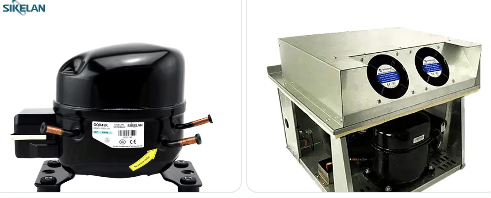
🔩 1) Compressor quality — the most critical part
Typical compressor life: 8–15 years
High-quality brands can exceed 15 years
Most machine failures are compressor-related
2) Cooling airflow & cleanliness
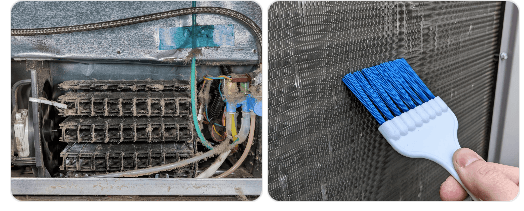
Dust is a silent killer.
If condenser coils clog:
❌ Compressor overheats
❌ Electricity use rises
❌ Lifespan drops dramatically
👉 Cleaning every 3–6 months can add years of life.
🔌 3) Usage conditions
Machines last longer when:
✅ Indoors
✅ Stable temperature (not in hot sun)
✅ Good ventilation around the unit
✅ Not overloaded with warm products constantly
Heat is the enemy of refrigeration systems.
Is R290 less durable because it’s propane?
No.
In fact:
✅ Thermodynamically efficient → less strain on compressor
✅ Used worldwide in commercial refrigeration
✅ Approved by major manufacturers
The only difference is flammability, not durability.
R290 machines usually:
✅ Use less electricity
✅ Run quieter
✅ Cool faster
✅ Have lower operating cost
Signs the compressor is about to fail ⚠️
The compressor is the heart of the cooling system. When it starts dying, the machine will warn you — if you know what to look for.
1) Unusual noises (early warning)
Normal: soft humming
Bad signs:
Loud buzzing or growling
Clicking on/off repeatedly
Knocking or rattling
Sudden increase in noise
👉 Clicking every few seconds often means hard starting or internal failure
2) Poor cooling or temperature rising
Symptoms:
Drinks not cold enough
Temperature slowly creeping up
Machine runs constantly but doesn’t cool
Previously cold items now lukewarm
⚠️ Could also be low refrigerant — but compressor is a major suspect.
3) Short cycling (starts and stops rapidly)
The compressor:
Starts
Runs a few seconds or minutes
Stops
Repeats over and over
Common causes:
Overheating
Internal wear
Electrical problems
Failing start relay
This behavior destroys compressors quickly.
🥵 4) Very hot compressor housing
Warm is normal. Too hot to touch = problem.
Overheating causes:
Dirty condenser coils
Poor ventilation
Internal mechanical wear
Electrical issues
5) Higher electricity use
If your power bill rises but sales don’t:
👉 The compressor may be running constantly trying to keep up
6) Compressor hums but won’t start
You may hear:
Loud hum
Then a click
Then silence
Repeats every minute or so
Often indicates:
⚠️ Locked rotor (mechanical seizure)
⚠️ Failed start capacitor/relay
⚠️ Compressor at end of life
Signs of imminent failure (call technician ASAP)
Burning smell
Tripping breaker or blowing fuse
Machine completely warm
Compressor silent when it should run
Oil residue around compressor or tubing
🏆 Expert tip for R290 machines
Because R290 systems are efficient, compressors often fail due to:
👉 Overheating from dust or poor airflow — NOT the refrigerant itself
Cleaning the condenser regularly is the #1 way to prevent failure.
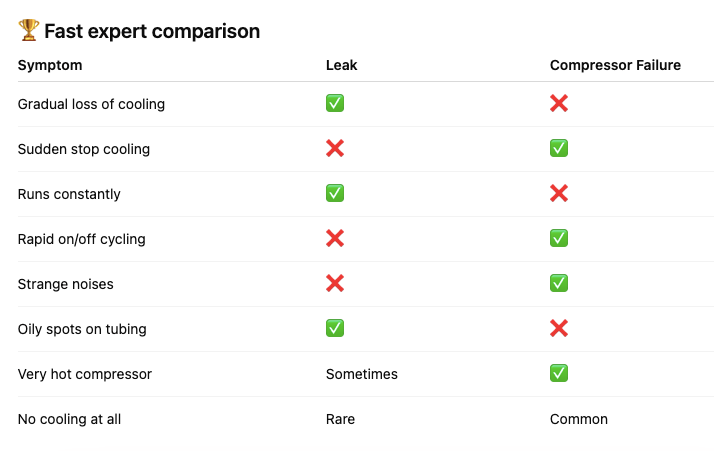
How to check if it’s refrigerant leak vs compressor failure
Refrigerant Leak vs. Compressor Failure — How to Tell
Both cause “not cold” machines, but the symptoms are different. Here’s how technicians (and experienced operators) distinguish them.
Signs of a REFRIGERANT LEAK (R290 in your case)
Typical symptoms
✅ Compressor runs continuously (never rests)
✅ Cooling weak or gradually getting worse
✅ Inside may be cool but not cold
✅ Partial frost on evaporator (only one corner/section)
✅ Oily residue on copper tubing joints
✅ No unusual compressor noise
👉 Refrigerant carries oil — leaks often leave oily spots.
What’s happening
Not enough refrigerant to absorb heat → system runs but can’t reach temperature.
Signs of COMPRESSOR FAILURE
Typical symptoms
❌ Loud buzzing, clicking, or knocking
❌ Compressor tries to start then stops
❌ Very hot compressor shell
❌ Breaker trips or lights dim on startup
❌ Machine not cooling at all
❌ Compressor silent when it should run
👉 Often sudden failure (worked yesterday, warm today)
🔎 QUICK DIY CHECKS (safe for non-technicians)
✅ 1) Listen test
Smooth steady hum → likely leak or airflow issue
Loud buzz + click → compressor/start problem
✅ 2) Touch test (carefully)
Back/bottom of machine:
Warm condenser pipes → compressor is pumping
Completely cool → compressor not working
⚠️ Hot is normal — burning hot is not.
✅ 3) Runtime behavior
Compressor never stops? → Leak likely
Starts/stops every few seconds? → Compressor issue
✅ 4) Cooling history
Gradual decline over weeks/months → Leak
Sudden failure overnight → Compressor/electrical
⚠️ Special note for R290 machines
R290 (propane) systems:
Use small refrigerant charge (like your 80 g)
Even a tiny leak can kill cooling
Repairs MUST be done by certified technicians (flammable gas)
Which is worse?
Compressor failure = usually more expensive
Leak repair + recharge: moderate cost
Compressor replacement: high cost
But small R290 systems are often repairable.
What about R134a systems? (Compared to R290)
R134a machines are much less restrictive and less hazardous to service.
👉 Key difference: R134a is NOT flammable
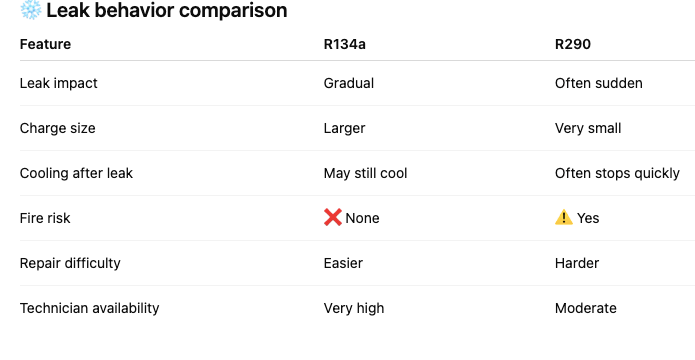
✅ Refrigerant charge size
R134a systems usually contain much more refrigerant than R290 systems.
Small vending machine: ~120–300 g (sometimes more)
Your R290 machine: only 80 g
👉 Result:
R134a leaks are often slower and less catastrophic
Machine may still cool for weeks/months
Performance gradually declines
Easier to diagnose early
🔥 Safety
R134a
✅ Non-flammable
✅ Non-explosive
⚠️ Still not harmless (can displace oxygen in confined spaces)
R290
⚠️ Flammable propane
⚠️ Ignition risk if leaked
⚠️ Strict safety procedures required
🧰 Who can repair it?
R134a systems
Repairs are easier legally and technically.
In the EU/Spain:
Technician must be F-Gas certified to handle refrigerant professionally
But no explosion risk procedures needed
Widely serviced everywhere
👉 Many older repair shops are very comfortable with R134a.
R290 systems
Stricter handling rules because of flammability:
Explosion-safe tools required
No sparks or open flames
Special recovery procedures
Training for hydrocarbons
Real-world example
Small leak in R134a vending machine
Drinks slightly less cold
Compressor runs longer
Can operate for a long time before failure
Same leak in R290 machine
Cooling may collapse quickly
Cabinet warms noticeably
System can stop performing within days
Expert bottom line
👉 R134a = safer and more forgiving ( models below 2024)
👉 R290 = more efficient but less tolerant of leaks ( models 2024 and up )
NO PROMO THIS MONTH
QUICKLINKS
First time owner guide
Must know before buying Android

Buy this ebook before purchasing a vending machine. Money back after you purchase a unit.
We are a vending solution provider that can handle all of your needs. Vending machines, system servicing, logistics, product procurement, and location search are all part of our comprehensive approach.
+63 976 093 3901
Vending Machine Ph by Itadish 2025